



Expert interview with Martin Bentz, CEO of Outlast Technologies
Modern soldier systems are becoming more advanced, more protective and more complex. But with every additional layer of equipment, the microclimate close to the body becomes more critical. Heat build-up, perspiration, cold bridges and loss of comfort can all affect endurance, concentration and operational readiness.
Outlast Technologies addresses this challenge with textile technologies designed to support thermal balance, comfort and performance in demanding environments: Outlast® Temperature Regulation and Aersulate® high-performance insulation. In this interview, Martin Bentz, CEO of Outlast Technologies, explains why thermal comfort is becoming an increasingly important factor in military and protective textile systems.
Mr. Bentz, why is thermal management becoming such an important topic in modern soldier systems?
Modern protective clothing has to do many things at once. It must protect, support mobility, be durable, and often integrate with additional equipment such as body armor, backpacks, communication systems or load-bearing gear. This creates highly complex clothing systems.
The challenge is that every additional layer also influences the microclimate close to the body. Heat can build up, moisture can accumulate, and the wearer may start to sweat even before the physical workload becomes extreme. In military environments, this is not just a comfort issue. Thermal stress can increase physical strain and may make it harder to stay focused over long periods.
That is why we believe thermal comfort should be seen as part of operational performance. If the body is less distracted by overheating, sweating or chilling, the wearer has better conditions to remain comfortable, alert and ready to perform.
In many cases, textiles focus on moisture management. Why is that not always enough?
Moisture management is important, but it usually starts when perspiration is already there. The textile reacts to sweat by transporting it away from the skin. That can be useful, but it means the body has already entered a state of thermal imbalance.
Our approach with Outlast® Temperature Regulation is different. The technology is designed to act earlier. It helps absorb excess heat, store it and release it again when needed. The goal is to support a more balanced microclimate before the wearer becomes too hot or too cold.
For military and protective applications, this can be highly relevant because wearers often move between different activity levels and environments. A soldier may stand still for a period of time, then suddenly become highly active, then return to a lower activity level. Textile systems must be able to support these transitions.
How does Outlast® Temperature Regulation work in simple terms?
The technology is based on microencapsulated natural wax. These tiny capsules can absorb excess body heat when the wearer becomes too warm. When the body or the surrounding microclimate cools down again, the stored heat can be released back.
This helps reduce temperature peaks and supports a more stable microclimate. It is not about making a textile cold. It is about creating a more balanced comfort zone.
For the wearer, this can mean less overheating, less perspiration build-up and a more comfortable feeling during changing conditions. In some applications, tests have shown perspiration reduction of up to 48%, depending on product construction and use case. In demanding environments, this can contribute to reduced physical discomfort and better conditions for focus and endurance.
Where do you see the strongest potential for Outlast® Temperature Regulation in military applications?
There are many possible areas. Base layers are an obvious example, because they are worn directly next to the skin and strongly influence the body’s thermal perception. But the technology can also be relevant in linings, mid layers, gloves, socks, sleeping systems or textile components used under protective equipment.
One interesting area is clothing worn under ballistic protection or other heavy gear. These systems often limit ventilation, which can make the microclimate more challenging. A textile technology that helps manage heat and moisture build-up can provide a real comfort benefit.
We also see potential in situations with changing temperatures: moving between vehicles and outside environments, between heated indoor spaces and cold outdoor conditions, or between high activity and rest phases.
You also focus on Aersulate®. What makes this technology interesting for military and protective textiles?
Aersulate® is a high-performance insulation technology based on aerogel. Aerogel is known for its extremely low thermal conductivity. The challenge has always been to bring this performance into textile structures in a practical and wearable way.
With Aersulate®, we can enable thin, flexible and high-performing insulation concepts. This is especially interesting for military applications because volume, weight and freedom of movement are always critical. If a jacket, glove or protective textile can be thinner while still offering strong insulation performance, this opens completely new design opportunities.
The technology can also support multifunctional textile constructions. For example, it can be combined with different textile carriers, including solutions for protective or flame-resistant applications, depending on the construction and material concept.
Why is thin insulation such an important advantage?
In military clothing, bulk is a major issue. Thick insulation can restrict movement, increase pack volume and make layering more difficult. It can also interfere with equipment such as body armor, harnesses or backpacks.
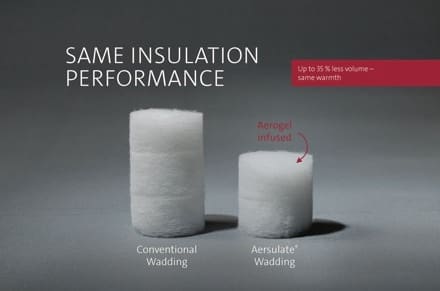
A thinner insulation concept can help designers create garments that are easier to wear, easier to pack and better suited to complex equipment systems. It can also support better fit and mobility.
Another important point is performance under pressure. In real use, insulation is often compressed – for example at the shoulders under backpack straps, at the elbows, knees or seat areas. Many conventional insulation materials lose performance when compressed. Aersulate® can help address this challenge by enabling insulation concepts that perform even in demanding constructions.
How does this connect to RCT values and measurable performance?
In technical textiles, performance must be measurable. RCT values are a key indicator for thermal resistance, showing how effectively a material slows down heat flow.
With Aersulate®, strong insulation performance can be achieved in very thin textile constructions. Depending on the article, Aersulate® fabrics with a thickness of only 1.1 reach RCT values of 0.08, combined with low thermal conductivity values down to 0.028 W/mK. This gives product developers more freedom to reduce bulk, work with slimmer constructions or design advanced multilayer systems while still targeting measurable thermal performance.
Aersulate® also shows its strength under pressure. In a test with a 100 °C heating plate and a 5 kg weight applied to the fabric, the Aersulate® felt reached only around 60 °C after 12 minutes, while a comparable felt without Aersulate® reached around 75 °C. This makes Aersulate® especially relevant for applications where insulation has to perform in limited space, under load or close to heat sources.
For military and protective markets, measurable performance is essential. It is not enough for a material to feel good in a showroom. It has to deliver reliable benefits in demanding real-world conditions.
You mentioned flame-resistant constructions. How important is that for this target group?
It can be very important, depending on the application. Military and protective textiles often have to meet multiple requirements at once. Thermal comfort alone is not enough. A fabric may also need durability, flame resistance, abrasion resistance, breathability, low bulk or compatibility with other equipment.
This is where textile engineering becomes interesting. Aersulate® is not just an insulation material; it can be part of a broader construction concept. Depending on the textile carrier and system design, it can contribute to multifunctional fabrics that combine insulation with other protective properties.
The future of military textiles is not one single function. It is the intelligent combination of functions in one system.
What is the biggest misconception about thermal comfort in protective clothing?
Many people still think of comfort as something secondary – something nice to have after protection and durability have been solved. But in demanding applications, comfort has a direct impact on the wearer.
If a person overheats, sweats heavily or feels cold during low-activity phases, this creates additional stress. The body has to work harder to maintain balance. Over time, this can affect endurance, concentration and the overall ability to perform.
Thermal comfort should therefore not be seen as a luxury. It is part of functional performance.
What message would you like to give to military equipment developers and textile engineers?
Do not look at thermal comfort as an afterthought. Consider it from the very beginning of product development.
A garment or textile system can meet all formal requirements and still be uncomfortable in real use if the microclimate is not managed properly. Especially in military and protective applications, where equipment is worn for long periods and under high physical stress, this can make a major difference.
Our message is simple: advanced thermal management can help create better conditions for the wearer. Less thermal stress, better comfort and more design freedom are not separate goals. They are part of the same performance story.
About Outlast Technologies
Outlast Technologies is the Temperature Specialist in Textile and develops solutions for apparel, bedding, footwear, protective clothing, military and technical textile applications. Its portfolio includes Outlast® Temperature Regulation, based on microencapsulated natural wax, and Aersulate® high-performance insulation, designed to enable thin, efficient and multifunctional textile constructions.
For more information, visit www.outlast.com.
Read the full article here